
Select the role and environment
Choose protocol, profile, network interface, security, model, and software or HIL execution target.

ChargeLink is an engineering platform for EVSE and EVCC simulation, protocol investigation, campaign execution, and integration with software or hardware test environments.
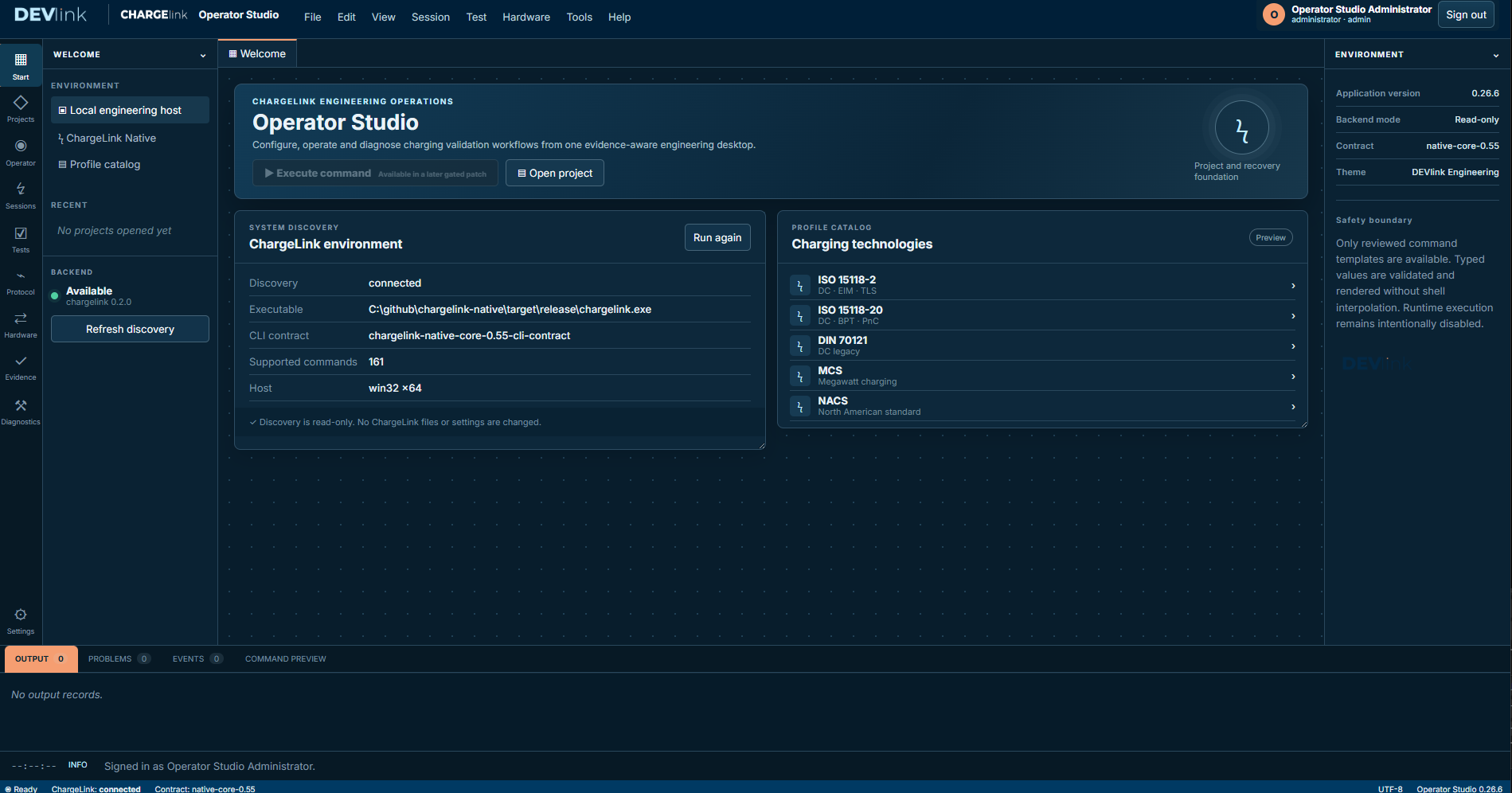
The interface keeps routine operation direct while exposing detailed configuration and analysis for advanced labs.
Choose protocol, profile, network interface, security, model, and software or HIL execution target.
Launch EVSE, EVCC, loopback, external-controller, or campaign workflows with explicit runtime status.
Follow discovery, transport, TLS, EXI, protocol states, model application, measurements, and faults.
Inspect traces, messages, diagnostics, run artefacts, and controlled support or review bundles.
In a HIL or hardware setup, ChargeLink can manage protocol roles, sessions, traces, scenarios, and result artefacts. The customer’s safety controller, power electronics, real-time I/O, and bench-specific adapters remain authoritative for physical actuation.
There is no public self-service download. DEVlink first agrees the protocol, role, controller or simulator, network, security, target bench, and acceptance evidence so the evaluation has a clear technical boundary.
Yes, within the implemented role and profile scope. The selected charging mode, transport, security, controller, and external simulator determine the exact evaluation setup.
No. The matrix reports DEVlink’s current internal engineering baseline. Accredited conformance, formal certification, and physical safety approval require separate authorities and evidence.
ChargeLink provides CLI, API, signal, and adapter boundaries for integration. The target platform, timing, signal map, safety chain, and hardware interface are reviewed before commitment.
Provide the role, protocol, charging mode, representative system, network and TLS expectations, current failure or test goal, and the result your team must produce.
Define the system boundary first, then prove the workflow with representative hardware or software.